Terraria NPC housing and happiness: every resident, every requirement
There are 26 town residents in Terraria, and every one of them has a trigger that makes them show up, a shop that opens once they are housed, and a set of preferences that quietly changes what they charge you. The wiki lists those preferences. Almost nothing else explains how to use them. This guide covers all three: who moves in and when, what each one sells, and how to lay out a town so you pay the minimum.
Why your NPC will not move in
This is the single most common Terraria support question, so start here. A room has to satisfy all of these at once:
- A static light source — a torch, candle or hanging lamp
- A door, and each NPC needs their own
- Enough space for the furniture to fit — 6 tiles tall and 10 wide overall, with roughly 4 by 8 tiles of usable interior
- Solid background walls on all sides, fully enclosed
- A table or work bench and a chair
- Platform floors must not cover more than half the floor area
Two more rules that cause the rest of the failures:
- Two NPCs can never share one house. This is the most common reason a guide fails even though every condition above is satisfied.
- Since 1.4.5, rooms no longer need at least one solid non-platform block. If you built a floor entirely of platforms and could not get the house to register, that is no longer the blocker — and the housing query now gives visual feedback that tells you specifically when a room fails because there is nowhere to stand.
All 26 residents
Filter by how you unlock them. The Old Man, the Traveling Merchant and the Skeleton Merchant are encountered characters rather than housed residents, and town pets and slimes are separate again.
| Resident | Move-in trigger | What they are for |
|---|---|---|
| Guide | Present from the start; takes the first valid house | Crafting recipes, and the Wall of Flesh summoning ritual |
| Merchant | Carry more than 50 Silver and a valid house | Basics: tools, ammo, potions |
| Nurse | Maximum life above 100 and a valid house | Heals to full, removes debuffs |
| Demolitionist | Carry explosives in your inventory | Grenades and bombs; freeze bombs at night after early bosses |
| Dye Trader | Hold a dye item, own a Dye Vat, and have 4 residents | Dye Vat and dyes |
| Angler | Find him on the Ocean shore and talk to him | Daily fishing quests and rewards |
| Golfer | Find him in the Underground Desert | Golf clubs, and better ones once you score |
| Traveling Merchant | Appears after you have several residents | Rotating stock from every shop |
| Princess | Rescued from the Underworld | Sells the DPS Stresser; liked by every other NPC |
| Dryad | Defeat the Eye of Cthulhu, any evil boss, or Skeletron | Purity service, sells seeds |
| Witch Doctor | Defeat Queen Bee | Imbuing Station, Blowgun, Jungle gear |
| Clothier | Defeat Skeletron | Costumes, hats and dyes |
| Painter | Have other residents and a valid house | Paint, dyes and coatings |
| Zoologist | Available once you start filling the Bestiary | Critters, and the Universal Pylon at 100% Bestiary |
| Tavernkeep | Defeat an evil boss, then find him unconscious underground | Ale, the Eternia Crystal, Old One's Army gear |
| Cyborg | Late-game boss progression | Powered armour and guns |
| Steampunker | Late-game boss progression | Powered armour and wire |
| Mechanic | After Skeletron, rescue her from the Dungeon | Wire, mechanical parts |
| Goblin Tinkerer | After a Goblin Army, rescue him from the Cavern | Tinker's Workshop, Rocket Boots, reforging |
| Wizard | After the Wall of Flesh, rescue him from the Cavern | Crystal Ball, Ice Rod, fountains |
| Stylist | Free her from a Spider Nest | Hair dye and removers |
| Pirate | After a Pirate Invasion | Pirate weapons and explosives |
| Truffle | House him in the Mushroom biome after Hardmode | Strange items and the truffle worm |
| Tax Collector | Hardmode, purify a Tortured Soul in the Underworld | Collects taxes from other residents |
How happiness actually works
Terraria does not show you a happiness score. Every resident carries a set of multipliers applied the moment you open their shop, and the shop shows a small icon with the exact number. Move an NPC, move yourself, or change who lives nearby, close the window and reopen it — the price updates immediately. That makes it a system you can test in ten seconds rather than plan for an hour.
Three things feed into it: biome, neighbours, and situation. The multipliers multiply together and round to the nearest 1%.
| Factor | You pay | They pay you |
|---|---|---|
| Loved biome or loved neighbour | 88% | 114% |
| Liked biome or liked neighbour | 94% | 106% |
| Disliked | 106% | 94% |
| Hated | 112% | 89% |
| Solitude bonus (2 or fewer within 25 tiles, 3 or fewer between 25–120) | 95% | 105% |
| Crowded penalty (each extra NPC within 25 tiles) | 105% | 95% |
| No home, over 120 tiles from home, or living in the Dungeon, Corruption or Crimson | 150% (fixed) | 67% (fixed) |
The bounds are the whole point: the best case is 75% of normal price and the worst is 150%. That is a two-times swing on everything you buy. Selling to a happy resident earns up to 133% of normal value; an unhappy one pays as little as 67%.
The three mistakes that cost you money
1. Biome preference reads where YOU are standing
Not where the NPC lives. You can move the Merchant into the Forest, which he likes, and still pay the Disliked multiplier if you are standing in the Snow when you open his shop. In practice you shop from inside the town, so it rarely bites — but it does bite when you talk to a wandering NPC, and it is the reason prices sometimes seem to change for no reason.
2. Crowding is counted per head, not per house
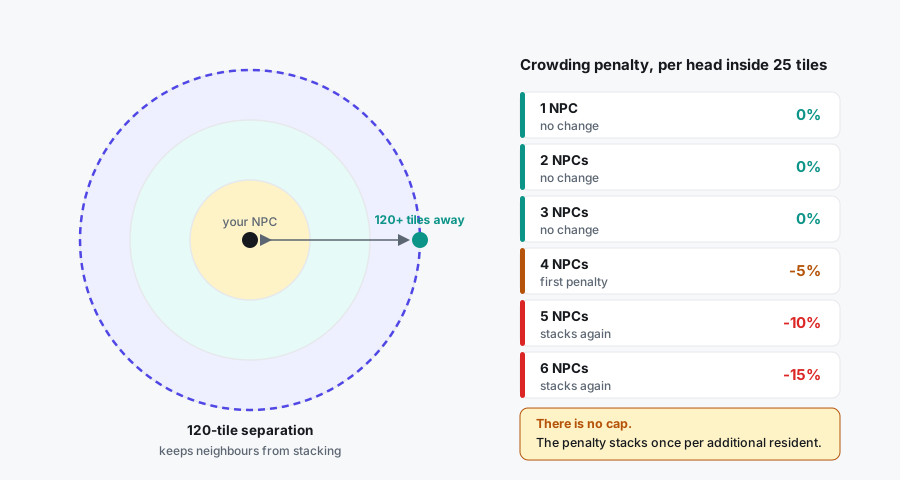
The neighbour radius is 25 tiles, measured Euclidean from each NPC's home tile — the block they stand on at night, directly under the middle of their flag. Every qualifying neighbour applies its own multiplier, so two loved neighbours is 0.88 twice, not 0.88 once.
- Three NPCs in one pod keeps the solitude bonus for everyone, because each of them only has two others nearby.
- A fourth NPC costs the bonus but adds no penalty.
- A fifth and beyond stack 105% each, with no limit.
- The solitude bonus also dies if more than three NPCs sit in the 25-to-120 tile band — two pods parked 60 tiles apart cancel each other's bonus.
3. "No home" overrides everything
An NPC with no valid home, more than 120 tiles from their house, or living in the Dungeon, Corruption or Crimson is pinned at 150% no matter how good the rest of their situation is. Neighbours do not override it. If prices suddenly jumped, something moved — fix the house first, then optimise the layout.
The town layout that keeps prices low
Build pods of two or three NPCs, and space each pod more than 120 tiles from the next. Not one big apartment block — that is the worst possible layout, because it maximises both the crowding penalty and the loss of the solitude bonus simultaneously.
A practical order of operations:
- Get every resident you want housed first. Nothing else matters until nobody is on the 150% penalty.
- Group residents by their preferred biome. A resident who likes the Forest should live in a Forest pod, not a Forest house in the middle of a Stone town.
- Place the Princess deliberately — she is the one resident whose presence improves everyone nearby.
- Measure from home tile to home tile, not house to house. The flag sits in the middle of the house, but the anchor is the block underneath it.
- Reopen a shop after every move and read the percentage. It updates instantly, so you can test a layout in seconds instead of rebuilding it blind.
What changed about Pylons in 1.4.5
A lot of Pylon advice online is out of date. In 1.4.5.0 the minimum happiness requirement for selling a Pylon was removed entirely. You no longer need a min-maxed town to unlock fast travel — any vendor sells the Pylon for the biome they live in, as long as at least one other housed NPC is nearby.
What still applies:
- To use a Pylon, both ends need at least two housed NPCs within a 169×124 tile rectangle centred on it, and each NPC must be inside that box and within 100 tiles of home.
- The Pylon must physically sit in its own biome.
- One of each type per world, and the minimap must be enabled.
- 1.4.5 added two new types: the Underworld Pylon and the Aether Pylon — house any NPC in the Underworld or the Aether to unlock them.
- The Universal Pylon, sold by the Zoologist once the Bestiary is 100%, works anywhere with no NPC requirement.